

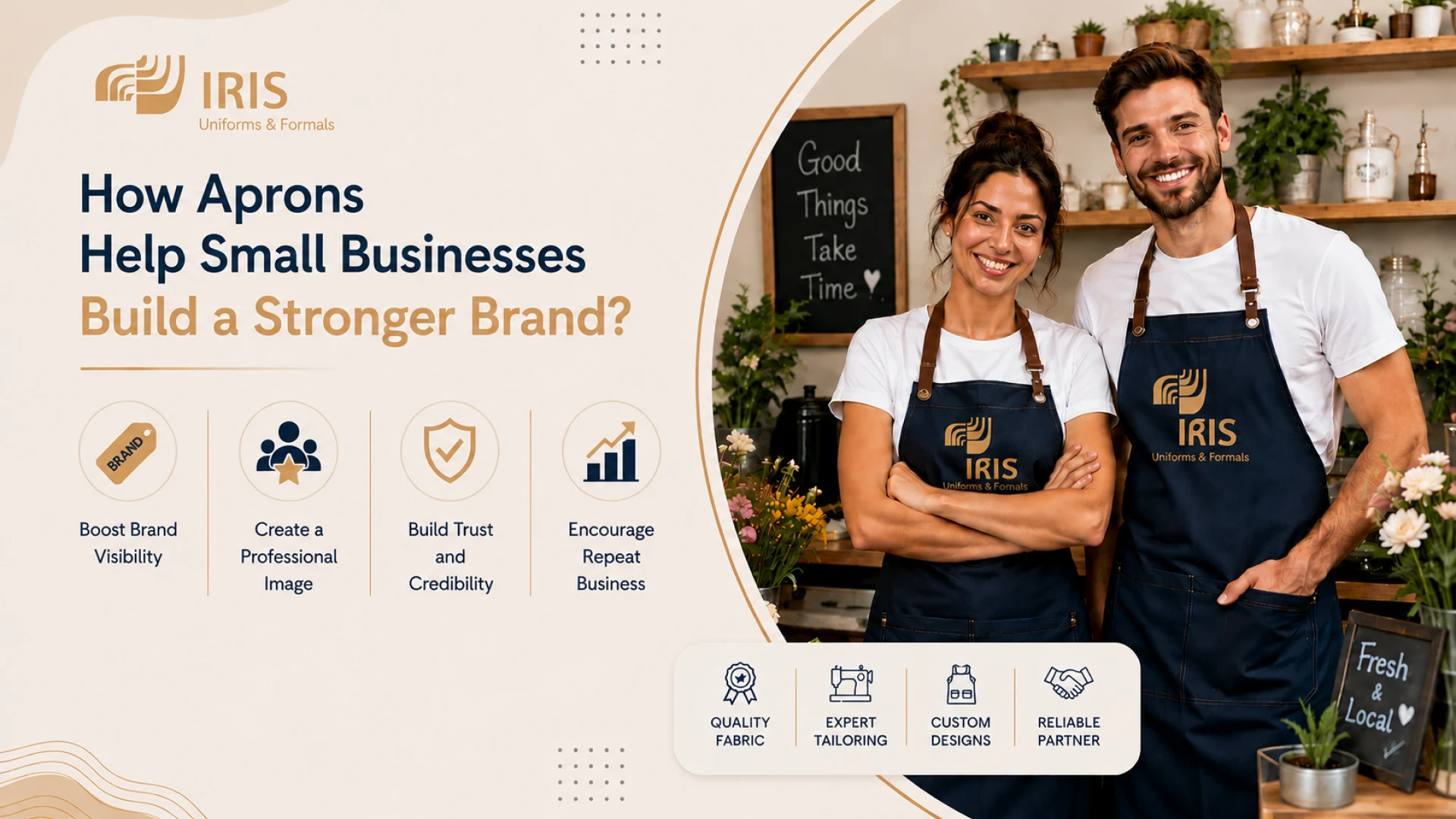
How Custom Aprons Help Small Businesses Build a Stronger Brand?
Walk into any busy cafe in Bengaluru or Mumbai right now and count how many things are actually “on brand”, the signage, maybe the cups, and usually not much else. Staff are often in whatever the owner could arrange in a hurry: plain black tees, mismatched aprons, sometimes no uniform at all. That’s the gap this post is about. How custom aprons help small businesses build a stronger brand isn’t just a nice idea for big chains with design budgets; it’s one of the most affordable branding moves available to a small business, and it’s exactly why custom aprons for cafes and restaurants in India have quietly become a standard part of opening a new outlet rather than an afterthought.
If you run a small business, a bakery, a salon, a boutique, a workshop, your apron is one of the few things that’s guaranteed to be in front of a customer for the entire time they’re with you. That’s a lot of unclaimed brand real estate.
How Custom Aprons Strengthen Brand Identity
Why Branding Matters More for Small Businesses
Big brands can afford to be forgettable for a day and still get remembered, because of sheer ad volume. A small business doesn’t have that luxury. You usually get one shot at a customer’s attention, and it happens in person, at the counter or the table. Everything a customer sees in that moment either confirms the place has its act together, or quietly suggests otherwise.
That’s why branding works best for small businesses when it’s built into everyday operations rather than treated as a separate project. A well-designed apron does this automatically. Set it up once, and it works every day the business is open.
India’s MSME sector is enormous, well over 7.5 crore registered enterprises, contributing close to a third of the country’s GDP, and most compete on the same street selling nearly identical products. In that environment, businesses that look deliberate and consistent tend to earn trust faster, even before a customer has tasted the coffee.
Custom Aprons as a Walking Advertisement
An apron isn’t static signage. It moves. Your barista walks table to table, your chef steps out to check on an order, and every time, your brand goes with them.
There’s real data behind this. Uniform and workwear research this year points to something worth noting: roughly three in four customers say they trust and feel more comfortable with clearly uniformed staff, and businesses that invest consistently in branded apparel report stronger brand recall than those that don’t. None of this needs ad spend; it’s already happening every shift.
There’s a quieter benefit too. Food and cafe photos almost always include whoever’s making the coffee or plating the dish. A plain, unbranded apron means your business disappears from that photo the moment it’s posted online, without you asking for anything.
Choosing the Right Apron Style for Your Brand
Not every apron style is suitable for every type of business, and choosing incorrectly is actually a very common mistake. A large bib apron, a good choice for a baker, might appear too big and bulky on a barista who needs to work quickly at the counter and espresso machine, leaving their hands free as much as possible. Like that, a waist apron with limited pocket space is very handy for servers who have to carry their notepad, pen and card machine, yet they won’t give the chef enough protection when they are near very hot oil and fires.
A few practical questions help narrow this down:
- What does the role actually involve? Someone standing at a fixed station needs different coverage than someone moving between tables all day.
- How messy is the work? Kitchens and bakeries need more coverage and tougher fabric than a front-of-house role.
- How long is the shift? Comfort over an 8–10 hour shift matters more than how an apron looks in a photo for five minutes.
- Does it need pockets, adjustable straps, or a cross-back design for comfort?
If you’re specifically outfitting kitchen staff, it’s worth looking closely at options built for that environment; we’ve gone deeper into fit, coverage, and fabric for that use case in this piece on custom aprons for chefs.
Fabric and Colour Choices That Reflect Your Brand
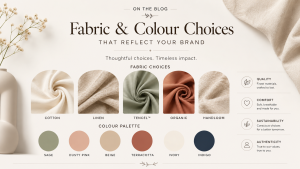
Fabric choice decides whether an apron still looks presentable after fifty washes, or is frayed and faded within a few months. For food businesses, a cotton-polyester blend holds colour well through frequent laundry. For workshops involving grease or rough surfaces, a heavier canvas or denim-style fabric lasts far longer.
Colour matters just as much, and it’s often decided too casually. Your apron doesn’t need to match your logo exactly, but it should sit comfortably alongside your existing signage, packaging, and website. Customers notice inconsistency even when they can’t say why something feels off. There’s also growing interest in more responsibly sourced fabric, recycled cotton blends and lower-impact dyeing, partly driven by customer questions and partly because it holds up well over time. We’ve covered that shift in why sustainable workwear is worth considering for a small business.
Logo Placement and Customization Options
A logo that’s too small gets missed entirely. A logo that’s too large can look like it’s trying too hard, especially on a business that’s meant to feel approachable rather than corporate. There’s a middle ground, and it usually comes down to a few decisions:
- Chest placement – the most common choice, visible in nearly every interaction without dominating the apron.
- Embroidery versus printing– embroidery not only looks good but it also is more durable. Printing, then again, is the better bargain when you want to print detailed, multi-coloured logos or even produce small numbers of products only.
- Tone-on-tone and Contrast- a logo of the same colour but slightly different shade as the base colour looks more luxurious and classy, whereas one that has high contrast with the background is more lively and stands out even from a distance.
- Identification tags- a simple name tag saying ‘Barista’, a first name, etc. underneath the logo, for example, can add a nice personal touch to which customers may respond very positively mainly in small, relation-based businesses where a personal connection is very important.
Actually, none of these design options have to be permanent but doing them properly right at the beginning will avoid the situation that you are going to have an order for new aprons after a couple of months only because the logo has lost its shine, its surface or has merely looked quite wrong when actually it was worn.
Custom Aprons vs Other Branding Investments
Small business marketing guidance in India this year generally points to spending 5–12% of revenue on marketing combined, most of it going toward digital ads, social media, and SEO, all recurring costs. The moment you stop paying, the visibility stops too.
Custom aprons work differently. It’s a one-time or occasional cost: order them, your team wears them, and the branding keeps working shift after shift. A signboard only works for people walking past your location; a social ad disappears when the budget runs out. An apron is present in every customer interaction for as long as it lasts, at a fraction of the ongoing cost.
That doesn’t mean aprons should replace digital marketing, but as a low-effort, high-repetition investment, they’re hard to beat for a small business watching every rupee.
How to Order Custom Aprons for Your Business
Ordering custom aprons for the first time is simpler than most small business owners expect, but a bit of planning up front saves real back-and-forth later:
- Decide the number of uniforms and the roles they are for. Normally kitchen staff, servers, and front-desk staff require different types of style, so it’s better to put in separate order for different role styles instead of buying one type for all.
- Send the logo file in the right format. A high-resolution vector file like AI, EPS, or PDF will result in the cleanest embroidery or print; a screen shot or low-quality JPEG almost always won’t.
- Choose textile based on the actual working conditions and not solely on the feeling of the samples in your hands.
- Order a sample before a big production run, especially when it’ll be your initial order from a supplier; colour accuracy and logo placement can be much easier to fix before 50 aprons are made and not after.
- Check the delivery schedule and how you can reorder as well, since you’ll be reordering the uniforms when personnel changes and uniforms get worn out.
Working with a supplier who understands small business timelines and budgets, rather than only handling large corporate bulk orders, usually makes this process a lot smoother. If you’re comparing options, this rundown of what to look for in a custom uniform supplier covers the questions worth asking before you commit to one.
Conclusion
A custom apron is a small piece of fabric that happens to sit at the centre of almost every customer interaction your business has. It’s cheaper than most marketing channels, it doesn’t need a monthly budget, and unlike a lot of “branding” advice, it doesn’t need a rebrand meeting to get started, just a logo file and a supplier who gets the details right. For a small business trying to look as professional as it actually is, that’s a fairly easy decision.