

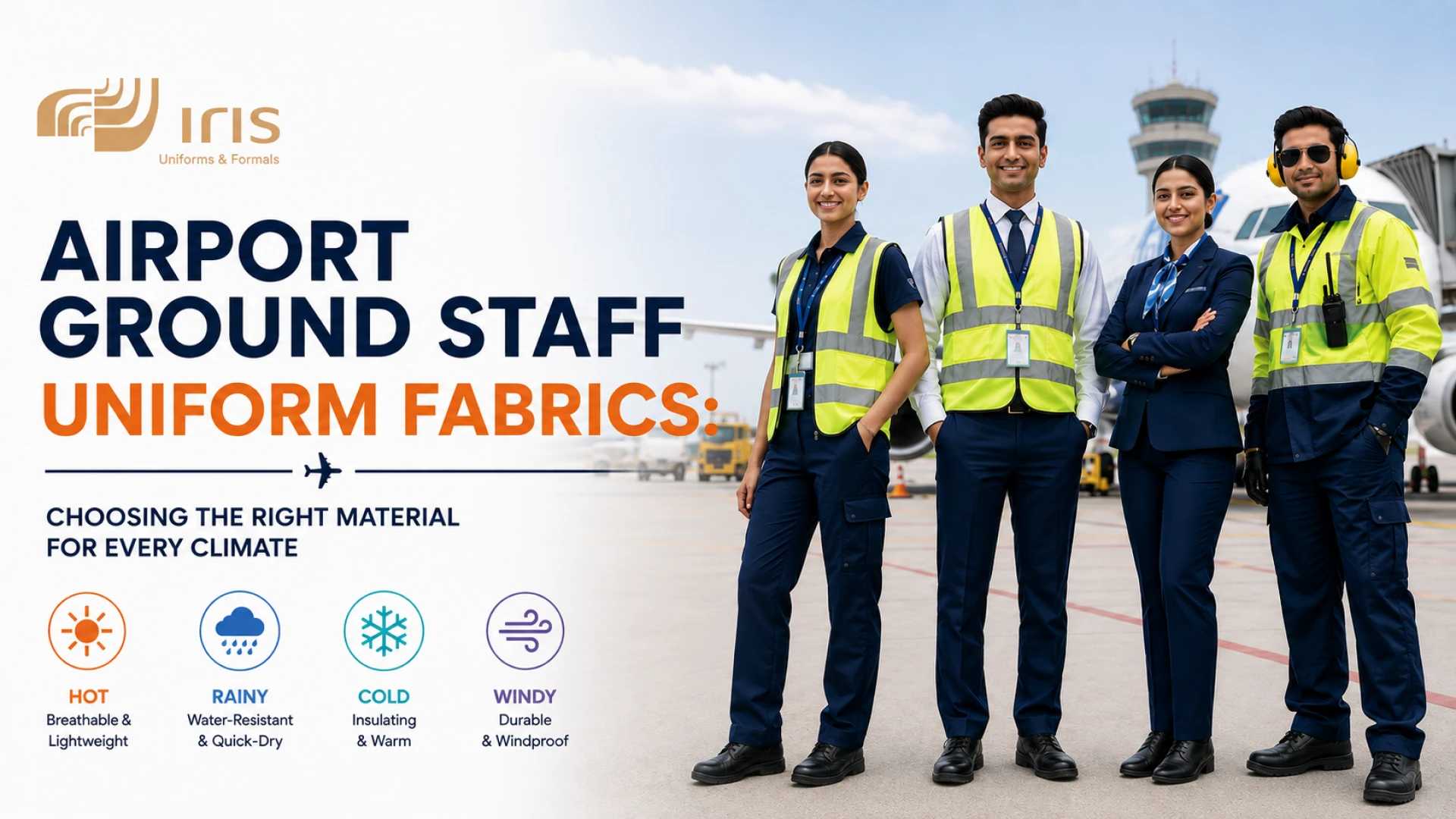
Airport Ground Staff Uniform Fabrics: Choosing the Right Material for Every Climate
Stand on any tarmac for ten minutes and you’ll understand why fabric choice matters more here than almost anywhere else in uniform design. Ground staff aren’t sitting at a desk in a climate-controlled office, they’re out in direct sun during a Delhi summer, standing in monsoon drizzle, or working a pre-dawn shift when the temperature’s dropped enough to need a layer. The wrong fabric doesn’t just look uncomfortable, it genuinely affects how well someone can do their job, hour after hour, shift after shift.
Choosing the right material for an airport ground staff uniform isn’t a styling decision, it’s closer to a safety and performance decision that happen to also need to look sharp. Here’s what actually goes into getting it right.
Why Fabric Selection Matters for Airport Ground Staff Uniforms?
Ground staff work is physical constant lifting, walking, signaling, and bending, all done in whatever weather the day brings. Airport staff uniforms that trap heat, restrict shoulder movement, or fall apart after a few dozen industrial washes aren’t just an inconvenience; they become a genuine productivity and safety issue.
There’s also a regulatory layer that doesn’t exist for most other uniform categories. Ground staff working airside typically need to meet high-visibility standards. In India, this generally means Class 2 or Class 3 compliance under IS 15809, which dictates not just color but the amount of reflective tape and fluorescent fabric a garment needs to carry. Get the fabric wrong, and you’re not just dealing with an uncomfortable employee; you’re potentially dealing with a compliance issue.
Key Factors to Consider When Choosing Airport Uniform Fabrics
A handful of specific properties separate a fabric that actually holds up on the tarmac from one that just looks fine on a hanger. Working with an experienced uniforms manufacturer can help ensure the right fabric is selected for demanding airport environments.

Comfort and breathability
Ground personnel spend their entire shifts on their feet either indoors or outside often working under sun. A material that doesn’t allow air penetration would heat and moisture would stay between the body and the material This way fatigue would develop early and the already taxing job would seem harder.
Durability and wear resistance
Bags, tools and general wearing down from all the walking contribute to the wearing out of ground staff uniforms. Material should be abrasion resistant at knees, elbows and shoulders without the fabric thinning or tearing a few months of wearing.
Moisture management
This calls for more than being able to breath. Moisture-wicking coatings pull sweat away from the skin to the fabric surface where it spreads and then the liquid turns into vapor – it was quite an essential function during damp weather or really hot days keeping employees dryer and comfortable for a shift.
Ease of maintenance
Airport uniforms are laundered over and over again in industrial washers so they must be resistant to washing – retaining the shape, color and structure. The fabric that gets easily wrinkled or shrinks Much after a few wash will definitely be headache and start to look slovenly well before they are worn out.
Professional appearance
Though, all these features are of no value if the uniform still looks plain or is not attractive. The material should look neat, prevent excess wrinkling through a shift, keep its color well, it is vital for bright yellows and oranges that will fade when the quality of the fabric is poor.
Best Fabrics for Hot and Humid Climates
For those employed at the portals during the Indian summer or recruited permanently from the humid coastal airports offshore, light weight polyester-cotton blends in the predominant 65/35 would prove most suitable between the poles of allowing enough ventilation and stability. Because of this, Yet nice cotton is for short term wear, the ample creasing and fabric durability after excessive industrial washing necessitates a blend of cotton and polyester for day to day comfort in extremely hot atmospheres.
Moisture-wicking synthetic finishes are worth prioritizing here specifically, technology that actively pulls sweat away from the skin makes a genuinely noticeable difference during a full shift under direct sun. It’s also worth being cautious about fabric weight, heavier fabrics above roughly 260 grams per square meter tend to trap heat and raise core body temperature faster than lighter alternatives, which matters a lot when staff are working extended outdoor shifts in serious heat.
Best Fabrics for Cold and Winter Climates
For those airports with truly cold winters, or if working very early in the morning or very late at night when the temperatures fall through the floor, then a heavier poly-viscose blend, or even a wool-blend in the outer layers, will provide insulation without losing that sharp, professional appearance. Poly-viscose has at various times been regarded as something of a fabric equivalent to Goldilocks. It has the air of being a sharp-looking fabric like wool, but still introduces the more breathable quality of cotton for that even in cold weather, people will invariably be working rather than stood around.
Underneath the thicker jacket, the kind of layers worn by employees can make a big difference in the cold weather. Wearing an inner layer that breathes while being covered by a shell that prevents the cold is the key to allowing employees to control their own degree of comfort as the temperature goes up from a pre-dawn near-freezing level and becomes more moderate in the afternoon.
Best All-Season Fabrics for Airport Ground Staff Uniforms
For airports and ground handling companies who desire an all-year round uniform style rather than having different uniforms for different seasons, polyester-cotton blends are probably still the best choice. They keep shape easily, colors remain intense even after the fabrics are washed multiple times, and there’s a relatively good balance between breathability and durability, which can cope with a wider range of temperatures as compared with either pure cotton or pure synthetic fabrics.
Recycled polyester mixtures are also becoming available more frequently for this kind of use, combining exactly these performance traits and, in addition, contributing to sustainability aspects which are very much in fashion at the moment for airports and ground handling companies as reflected by their uniform policies.
How Layering Can Make Airport Uniforms Suitable for Changing Weather?
Airport shifts rarely happen in one consistent temperature. A ramp agent might start a shift in cool early morning air and be working under full sun by mid-morning, or dealing with sudden monsoon rain mid-shift. Layering solves this far better than trying to find one fabric that does everything.
A breathable, moisture-wicking base layer, which is comfortable and helps the body cool down is a good choice, together with the removable high-visibility outer layer, these two layers work well and give employee staff the flexibility to adapt to changes in conditions, during the same shift without them having to change clothes or put up with the wrong temperature for hours. The reason this two-piece system has been gaining popularity is mainly due to the unpredictable and rapidly changeable nature of airport weather conditions during a single working day.
How to Choose the Right Fabric for Airport Ground Staff ?
Not every ground role has the same fabric needs, and treating the entire ground team as one uniform category tends to underserve at least some of them.
- Baggage handlers and ramp agents need genuinely abrasion-resistant fabric with reinforced knees and elbows, given the constant contact with baggage, equipment, and cargo surfaces, alongside high-visibility compliance for their proximity to moving aircraft and vehicles.
- Aircraft marshals need similarly rugged, high-visibility fabric, but with a stronger emphasis on full range of motion in the shoulders and arms, since their job is literally built around large, clear hand and arm signals.
- Maintenance and technical staff often require additional properties like flame resistance or chemical resistance, depending on the specific work, which changes the fabric conversation entirely from comfort-first to compliance-first.
- Customer-facing ground staff, check-in counters, gate agents, tend to prioritize a more polished, wrinkle-resistant fabric since their uniform is doing double duty as both workwear and a passenger-facing brand touchpoint.
Work with a custom uniform supplier in India experienced specifically in aviation and airport workwear, since the fabric performance requirements here are genuinely different from general corporate uniform sourcing, and a supplier without that specific experience is more likely to miss something that only shows up once staff are actually wearing the uniform on the tarmac.
Conclusion
Getting airport ground staff uniform fabric right isn’t about picking the most premium material available, it’s about matching the fabric properties, breathability, durability, moisture management, visibility compliance, to the actual climate and role your team is working in every single day. A well-chosen fabric quietly supports staff through long, physically demanding shifts, while the wrong one becomes a daily source of discomfort and, eventually, a maintenance and compliance problem too.
If you’re building out or refreshing a uniform program, browse our full range of airport staff uniforms built specifically around these climate and role-based fabric considerations, or explore how thoughtful design supports comfort in our piece on cabin crew uniform design for comfort.
FAQs
What is the best fabric for airport ground staff uniforms in hot climates?
Lightweight polyester-cotton blends with moisture-wicking finishes tend to perform best in hot, humid conditions, offering breathability without sacrificing the durability ground staff work demands.
Do airport ground staff uniforms need to be high-visibility compliant?
Yes, in most cases. Staff working airside near moving aircraft and vehicles typically need Class 2 or Class 3 high-visibility compliance, which affects both the fabric color and the amount of reflective tape required.
Can one fabric work across all seasons for ground staff uniforms?
Polyester-cotton blends offer a reasonable all-season balance, though airports with extreme seasonal shifts often benefit more from a layering approach, a breathable base with a seasonal outer layer, rather than one fabric trying to do everything.
How often should airport ground staff uniform fabric be tested for wear?
Fabric should hold its shape, color, and structure through repeated industrial washing without significant shrinkage or fading, most quality fabrics are tested against a standard of minimal shrinkage after multiple industrial wash cycles before being approved for airport use.
Why does fabric choice differ between ground staff roles?
Different roles face different physical demands, baggage handlers need abrasion resistance, marshals need full range of motion, maintenance staff may need flame or chemical resistance, so fabric selection should be matched to the specific role, not applied uniformly across the entire ground team.





Pingback: How Custom Airline Uniforms Strengthen Brand Identity