


Custom Hospital and Medical Uniforms in India: Complete Guide 2026-27
Walk into any well-run hospital in India and one of the first things you notice is how easy it is to tell who does what. The doctor in the white coat, the nurses in a distinct colour, the ward boys and housekeeping in something different again. That is not an accident, it is a system, and uniform design sits right at the centre of it.
Hospital administration and procurement people should not ignore this. The right set of custom hospital uniforms sends across professional vibes to the patients, builds confidence in staff members, and helps in quick identification in such a chaotic setting. But the wrong fabric, incorrect sizing, lack of color coding and other mistakes in uniforms are just plain annoying.
This guide addresses everything you would need to know when placing orders for custom hospital and medical uniforms in India in 2026.
Why Custom Hospital and Medical Uniforms Matter in 2026
However, the argument in favor of customized uniforms over generic uniforms has become even more convincing. Numerous studies conducted by Indian healthcare apparel manufacturers have found that healthcare personnel wearing proper-fitting uniforms with good breathability experience less fatigue while working for extended periods, especially given the fact that a nurse or physician can be standing for 10-12 hours in a row.
Moreover, customized uniforms make it possible to include role identification, branding, and standardized fabrics into your uniform policy, something that generic uniforms fail to accomplish. For any private hospital or multi-speciality hospital chain, having consistent uniforms in different departments is a part of the professional image they aim to create.
Hospital Staff Uniform vs Medical Staff Uniform: What Is the Difference?
However, there is a distinction which is helpful when you place your order.
The term “hospital staff uniforms” includes all possible non-medical roles of a hospital: ward assistants, cleaning workers, receptionists, security services, administrative staff and canteen personnel. They should be durable, easily washable, and distinguishable by colors.
By contrast, the “medical staff uniforms” mean only clinical workers, doctors, nurses, surgeons, laboratory assistants, occupational therapists. Their needs are much more specific: the fabrics should be able to endure high-temperature wash cycles, have anti-microbial properties, pockets in certain places, as well as be suitable for sterile environment.
So it will be useful to distinguish these two groups right from the beginning of your communication with the manufacturer of hospital uniforms. Fabric specifications, number of items required per person and their designs differ sufficiently to become separate lines of an order.
Types of Custom Hospital Uniforms Used in Indian Hospitals
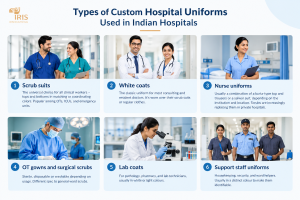
- Scrub suits: The universal choice for all clinical workers – tops and bottoms in matching or coordinating colors. Popular among OTs, ICUs, and emergency units.
- White coats: The classic uniform for most consulting and resident doctors. It’s worn over their scrub suits or regular clothes.
- Nurse uniforms: Usually a combination of a kurta-type top and trousers or a salwar suit, depending on the institution and location. Scrubs are increasingly replacing them in private hospitals.
- OT gowns and surgical scrubs: Sterile, disposable or washable depending on usage. Different spec to general ward scrubs.
- Lab coats: For pathology, pharmacy, and lab technicians, usually in white or light colours.
- Support staff uniforms: Housekeeping, security, and ward helpers. Usually in a distinct colour to make them identifiable.
Best Fabrics for Hospital and Medical Uniforms
Fabric is one of the most important decisions in any hospital uniform order, and also one of the most underestimated. The wrong fabric leads to uniforms that feel uncomfortable after a few hours, fade after a few washes, or fall apart faster than expected.
| Fabric | Best For | Why |
| Cotton-polyester blend (65/35) | General ward, nursing | Breathable, durable, holds shape after washing |
| 4-way stretch fabric | Scrubs, surgical teams | Freedom of movement during long active shifts |
| Antimicrobial treated fabric | ICU, OT, clinical staff | Reduces bacterial growth on fabric surface |
| Pure cotton | Tropical hospital environments | Maximum breathability in hot, humid conditions |
| Quick-dry polyester | Support staff, housekeeping | Handles frequent washing, dries fast |
In the context of Indian hospitals, breathability takes precedence over other qualities, at least for cooler seasons. A good general-purpose fabric for clinical workers would be an antimicrobial 4-way stretch cotton-poly blend. See the latest hospital uniform fabrics if you want to learn about current trends in 2026.
Colour Coding for Hospital Staff Uniforms
The main practical value of color coding is that it allows to recognize from afar which uniform should be approached for particular reasons. There is no nationally recognized code in India, but most hospitals use a similar approach:
| Role | Common Colour Choice |
| Doctors / consultants | White coat over personal clothing or scrubs |
| Nurses | Light blue, sky blue, or white |
| OT / surgical staff | Green or teal scrubs |
| ICU staff | Dark blue or navy |
| Lab / pharmacy | White or light grey |
| Housekeeping | Distinct colour (maroon, brown, or burgundy) |
| Security | Navy or dark grey |
| Reception / admin | Hospital brand colour or formal attire |
In case your hospital doesn’t have a colour policy yet, you could use this opportunity while placing the order for the uniforms to set one. Once everyone gets used to the color pattern, it becomes really difficult to change it afterwards.
Branding Your Medical Staff Uniform: Logo, Name and Designation
And that’s where custom uniforms become something generic uniforms will never be. Hospital’s logo embroidered on the front of the uniform, name badge bearing the name of the staff member on it, or even better – embroidered directly on the uniform along with their designation under it.
Common branding options offered by most uniform manufacturing companies in India are chest embroidery for hospital logo, name and designation either printed or embroidered on the left side of the chest/sleeve and department tags. More expensive uniforms also offer woven labels and branded buttons with the hospital’s logo.
Branding should be simple and consistent. No more than one logo, one name and one designation per uniform. Over-branding a uniform doesn’t make it look professional; it makes it look cluttered.
Hospital Uniform Procurement Checklist
- Role list with headcount per role
- Size breakdown (measure actual staff, do not guess)
- Colour specification per role
- Fabric spec (blend, antimicrobial requirement, stretch)
- Design spec (collar type, pocket count and placement, sleeve length)
- Branding requirements (logo, name, designation)
- Quantity per person (minimum 2–3 sets recommended for daily-use roles)
- Washing and care requirements
- Delivery timeline and phasing
How to Choose a Hospital Uniform Manufacturer
Not every uniform manufacturer has experience with medical and healthcare requirements. A few things that separate a good hospital uniform manufacturer from a generic apparel supplier:
- Experience with hospital-specific fabrics (antimicrobial, stretch, high-wash durability)
- Ability to handle multiple roles and designs in one order
- Sample and approval process before bulk production
- Consistent size grading across large orders
- Branding capability (embroidery, printing, labelling)
- Clear lead times and reorder process for replacements
For a detailed breakdown of what to look for, Iriswear’s guide on how to choose the best hospital uniform manufacturer is a useful starting point before you begin comparing suppliers.
Uniform Trends to Watch in 2026
A few shifts worth noting if you are placing an order this year:
- Scrubs replacing traditional nurse uniforms in private hospitals, particularly in metro cities. More practical for active clinical roles.
- Customized clothing is gaining momentum. Indian health care professionals, specifically women, have shown resistance to uniforms that are meant for an average body shape. Manufacturers are catering to this need by designing uniforms that fit Indian body shapes.
- Antimicrobial fabric is being made compulsory for clinical jobs instead of being optional. Hospitals that follow infection control procedures are making it compulsory for their employees.
- Sustainability is entering procurement process discussions. Hospitals are considering the use of recyclable fabric and robust construction in their uniforms.
FAQs
What is the minimum order quantity for custom hospital uniforms in India?
Indian companies typically have a MOQ of 50-100 pcs per design. For small hospitals, it may be possible to get a reduced MOQ by grouping multiple positions under one order, or going for a smaller manufacturer which caters to smaller hospitals.
What fabric is best for hospital scrubs in India’s climate?
A cotton-polyester material with 4-way stretch seems to work best in the majority of hospitals in India. Breathability for hot weather, wash durability, antimicrobial treatment needed for ICU/OT/high contact positions.
Can logos and names be added to hospital uniforms?
Embroidery and printing are both offered. Most manufacturers can do chest embroidery (for logo), and/or name/designation embroidery or printing on other areas. Ensure this is done during the sampling process to make sure placement and sizing is correct prior to mass production.
How many uniform sets should each staff member receive?
A minimum of 2–3 sets per person is recommended for roles where uniforms are worn daily. Clinical staff who wash after every shift may need 3–4 sets to avoid wear and rotation gaps. Factor in a small percentage for replacement orders during the first year.
How long does a custom hospital uniform order take in India?
From confirmed design and sizing to delivery, most manufacturers take 3–5 weeks for a standard order. Larger orders with multiple roles, embroidery, and custom fabrics may take 6–8 weeks. Build buffer time into procurement planning, especially ahead of hospital openings or annual uniform cycles.