

How to Choose Durable Workwear for High-Intensity Manufacturing Operations
What does a torn sleeve near a conveyor belt actually cost you? Manufacturing workers face a recordable injury and illness rate of 2.7 per 100 full-time employees, noticeably higher than the 2.3 average across all private industry, and proper protective clothing is estimated to prevent over 60% of workplace injuries when it’s actually built for the job. The gap between “workwear that looks the part” and “workwear engineered to hold up” isn’t a small detail. It can be the difference between a shift that runs smoothly and one that ends with an incident report.
Getting workwear wrong on a high-intensity factory floor doesn’t just mean replacing uniforms more often, it means safety gaps, lost productivity, and a compliance headache nobody wants during an audit. Here’s how to actually choose gear that holds up.
What Makes a Manufacturing Environment “High-Intensity”?
Workplace uniforms are not a one-size-fits-all kind of thing because the conditions at a workplace vary. A highly demanding environment can involve constant exposure to heat from furnaces, welding stations, and poorly ventilated heavy machinery, along with regular contact with sharp edges, rotating parts, and abrasive surfaces. To top it all, you have very long shifts – 10 to 12 hours, day after day, and repetitive strain due to the same reaching, bending, and lifting motions hour after hour – and so comes an environment that wears even the finest fabric through way faster than any regular office or retail uniform ever could. A work outfit that looks good and feels comfortable in a low-use setting may quickly wear down when exposed to this kind of daily wear and tear.
Why Durability Should Drive Your Buying Decision
The cheapest uniform on the quote sheet is rarely the cheapest one over a year. A uniform that tears after eight weeks and needs replacing means buying twice, paying for rush production, and running workers in compromised gear in the gap between. Durability isn’t a premium feature to consider if budget allows, it’s the actual cost driver, since the total cost of ownership, price per wear, replacement frequency, downtime risk, tells a very different story than the upfront invoice.
Fabric & Material Factors That Determine Durability
Abrasion, Tear & Snag Resistance
The fabric weight and weave density really help in this context. Ripstop weaves as well as cotton-poly blends that are tightly woven are far less likely to suffer from snagging on a machine and tearing under sudden strain, compared to lighter and looser fabrics that initially look pretty hanging. Still, in no time they will turn out to be the very fabrics that cause all the damage.
Heat, Flame & Chemical Resistance
If you are working with things like welding, furnaces, and handling chemicals, flame-resistant (FR) and chemical-resistant treated fabrics are essential features, not some nice extras they may add. Plain cotton or polyester mixes can actually result in various problems that range from molting, bursting into flames or even getting worn out by the very type of dangers that the high-intensity floor gives every day.
Breathability for Long, High-Output Shifts
The durability that comes at the cost of comfort works in reverse: workers sweating from being in heavy, non-breathable fabric get more comfortable or at least take off the protective gear when they really need such protection to be in place. Fabrics that combine real durability with air circulation, wicking away moisture, and having sections with mesh keep the protective gear being worn during the entire shift rather than abandoned halfway through.
Safety Features That Can’t Be Compromised
 Reinforced Stitching & High-Wear Zones
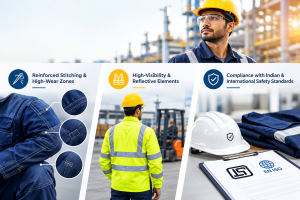
The factory workers usually bend and twist the most in the parts of the body where the cloth of the garments meets, like elbows, knees, and the junction of the sleeves at the shoulders. That means double-stitching or bar-tacking in such sensitive points is what enables a factory shirt to last one season only, compared to a factory shirt that can last a whole two years with little or no damage.
High-Visibility & Reflective Elements
Anywhere forklifts, cranes, or moving machinery share space with workers, high-visibility fabric and properly placed reflective strips aren’t a nice-to-have, they’re a genuine safety requirement that directly reduces struck-by incidents, one of the leading causes of serious injury in manufacturing settings specifically.
Compliance with Indian & International Safety Standards
Workwear needs to meet the specific standards relevant to your industry and region, whether that’s IS certification requirements domestically or international standards like EN ISO for flame resistance and high-visibility gear. Our detailed breakdown of safety uniform requirements for industrial workers covers exactly what compliance actually looks like in practice, not just on paper.
Fit, Mobility & Ergonomics on the Factory Floor
Wearing a durable uniform that limits the worker’s movement actually brings safety problems, as the workers adjust their body positions and even loosen their protective gear in compensation for the ill-fit. The design of features such as knee bends, underarm gussets, and articulated cuts is just as important as fabric strength. A uniform that makes it difficult to reach, bend, or crouch can become uncomfortable to wear, leading to frequent replacement or being left aside altogether. When that happens, the protection the uniform was designed to provide is compromised.
How to Judge Manufacturing Quality Before You Order
Wash & Wear Durability Testing
Before committing to a bulk order, request wash-cycle test results or a sample run through your own facility’s actual laundering process. Industrial washing is considerably harsher than standard laundry, and fabric that looks strong off the shelf can degrade fast under repeated industrial wash cycles specifically.
Stitching, Seams & Reinforcement Checks
Examine seam density, stitch count per inch, and reinforcement at key stress points on an actual sample garment rather than relying only on the specifications. Our detailed guide on durability in industrial uniform manufacturing walks through exactly what to check before signing off on a bulk order, since this is precisely where a lot of buyers get caught out later.
Choosing the Right Industrial Uniform Manufacturer
Track Record & Bulk Production Capability
A manufacturer’s actual experience with high-intensity industrial workwear specifically, not general corporate apparel, matters more than a polished catalogue. Ask directly about their production capacity for your order size and their track record supplying similar manufacturing environments, references from comparable facilities are worth more than any brochure claim.
Customization, Branding & Fit Consistency Across Teams
Sizing consistency across a large workforce, and the ability to customize for role-specific needs, welders needing different protection than machine operators, for instance, separates a genuine industrial uniforms manufacturer from a generic supplier working off a single template for every client.
Maintenance Tips to Extend Workwear Life
Uniforms should always be cared for according to the manufacturer’s guidelines. Follow the recommended maximum washing temperature, as higher temperatures can damage flame-resistant finishes and protective coatings faster than normal wear and tear.
Regularly check uniforms for small cuts, loose threads, or damaged seams. Finding these issues early makes it easier to repair the uniform instead of replacing it. Each employee should have at least two or three uniform sets to allow proper rotation and reduce excessive wear on a single set.
Protective gear and equipment should also be stored in suitable conditions. Avoid humid or extremely hot areas, as these can affect fabric quality and reduce the life of the uniform.
Conclusion
Durable workwear isn’t an upfront cost to minimize, it’s a genuine investment in worker safety, uptime, and the total cost of running a uniform program over its real lifespan, not just its purchase price. Getting fabric, safety features, fit, and manufacturer quality right from the start avoids the far more expensive cycle of premature replacement and compliance gaps down the line. If you’re ready to source workwear built for genuinely high-intensity conditions, explore what a proper worker uniform manufacturer can build around your specific floor.
FAQs
What fabric is best for high-intensity manufacturing workwear?
Tightly woven cotton-poly blends or ripstop fabrics generally offer the best balance of abrasion resistance and durability, with flame-resistant or chemical-resistant treatments added for environments involving welding, furnaces, or chemical handling specifically.
How often should industrial uniforms be replaced?
This depends heavily on fabric quality and wear intensity, but a well-made uniform in a high-intensity environment typically lasts 12 to 18 months with proper care, compared to just a few months for lower-quality gear.
Do high-visibility requirements apply to all manufacturing roles?
Not universally, high-visibility requirements generally apply to roles working near moving machinery, forklifts, or cranes specifically, though many facilities standardize hi-vis elements across the entire floor for consistency and simplicity.
Can workwear be customized for different roles within the same facility?
Yes, a genuine industrial uniform manufacturer can tailor protection levels, fabric weight, and features by role, welders, machine operators, and general floor staff often need meaningfully different specifications within the same facility.
What’s the biggest mistake buyers make when ordering industrial workwear?
Prioritizing upfront price over total cost of ownership is the most common mistake, cheaper uniforms that wear out fast end up costing more in repeat orders, downtime, and compromised safety than a properly durable option would have from the start.