

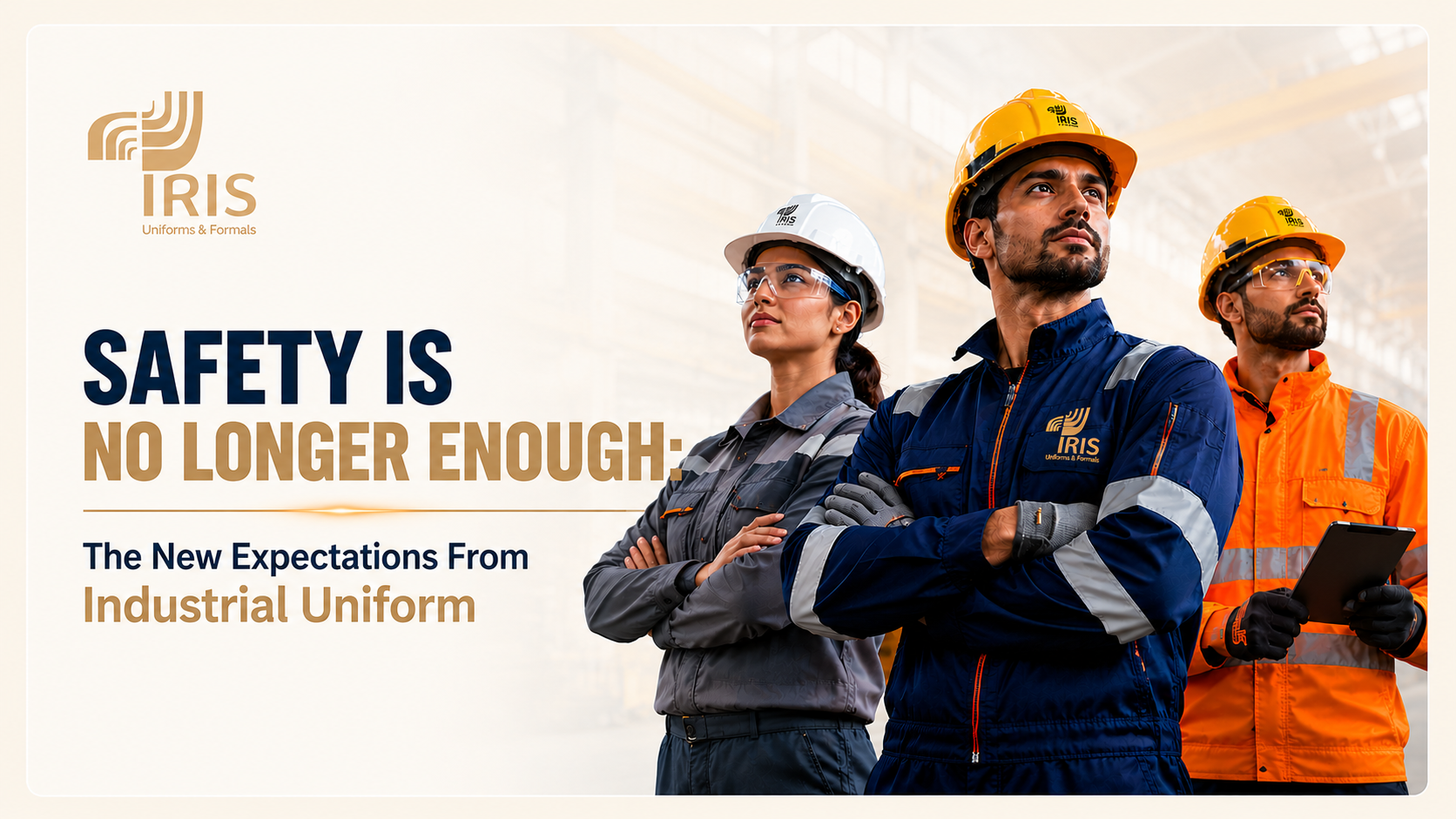
Safety Is No Longer Enough: New Expectations From Industrial Uniform
Recall the last time someone on your factory floor raised a complaint about their work uniform. Too rigid. Too hot. Too heavy In particular after a long shift. Most likely you just made a note and carried on because you figured that as long as the uniform met the safety requirements, the work was done, right?
Well, that kind of thinking is becoming obsolete very quickly.
The manufacturing sector has mostly undergone a dramatic change in what worker expect from the clothing they wear for eight to twelve hours a day. Safety is still important; no one is denying that. Though, if you are still choosing employee uniforms only based on compliance, you are already one step behind the companies that are thinking bigger.
1. Industrial Workwear Has Evolved, Whether You Noticed or Not
Not so long ago, industrial workwear had one job: keep the worker safe. You would grab flame-resistant, high-visibility, or chemical-proof stuff, depending on the setting, tick the PPE box, and move on, like that was all.
But look where we are now. The global industrial workwear market was valued at over USD 73 billion in 2025, and it’s moving toward USD 92 billion by 2034. Growth like that doesn’t show up only because more plants are opening. It happens because what companies buy has genuinely shifted.
Across construction, manufacturing, logistics, and energy, businesses are now treating work uniforms like a whole bundle, one package that covers safety, sure, but also coziness, efficiency, brand presence, and environmental responsibility. The factories doing it right aren’t simply purchasing gear. They are putting together a better workplace, one garment, piece by piece.
2. From Protection to Performance, What’s Actually Changed?
Here’s a question worth sitting with, like for a minute at least: does your current factory worker uniform actually help your team do their job better, or does it just keep them compliant?
There’s a real difference between the two, and honestly it shows up fast on the floor.
A well-designed industrial uniform removes friction from the workday. A technician who can reach , bend and move without fighting their clothes tends to stay more locked in. A welder whose gear fits the way their body moves in real time gets less drained by the end of the shift. And no, these aren’t little details, they hit output, accuracy, and on-floor morale, pretty directly.
These days, industrial workwear is being designed around movement. Stretch panels where it counts, reinforced knees that don’t mess with a crouch, sleeve lengths that stay put instead of riding up. It’s that kind of stuff that good worker uniform manufacturers are focusing on right now. Safety is the baseline, sure. But performance , that’s what separates “fine” from actually great.
3. Comfort or Functionality, What Matters More?
Ask any factory manager what drives uniform complaints, and it usually comes down to one thing: the workers don’t want to wear it. Too tight, too rough, too warm, whatever the reason, a uniform that feels bad gets in the way of a good day’s work.
This is something industrial uniform suppliers are increasingly being pushed on. The expectation has shifted from “is it safe?” to “will my team actually want to wear this every day?”
And the data backs this up. Globally, worker comfort is now cited as one of the top factors in uniform procurement decisions, not just for corporate roles, but across industrial and factory settings too. This reinforces the role of industrial uniforms in workplace safety, as comfortable employees are more focused, more confident, and less likely to work around their gear in ways that create actual safety risks.
What does functional comfort look like in practice? Think breathable fabrics for workers in high-heat environments, anti-odour treatments for long shifts, and ergonomic cuts that work with the human body rather than against it. India’s industrial workforce, operating across factory floors in cities like Jaipur, Pune, Ahmedabad, and Chennai, deals with serious heat and humidity. A safety uniform that doesn’t account for Indian climate conditions is already failing before it’s even been worn.
4. Advanced Fabric Technology For Industrial Workwear
This is where it gets genuinely interesting. The fabrics going into today’s industrial workwear are not the same fabrics from five years ago. Like, they changed. A lot.
Moisture wicking textiles, which pull sweat away from the skin and let it evaporate quickly, have become close to the norm for quality industrial workwear. Flame resistant treatments are now lighter as well, and they also stay tougher, holding up through more wash cycles without losing their properties. Anti static finishes are being built into garments used in electronics manufacturing and in hazardous environments, too.
And then there is that emerging category of smart textiles. Fabrics with sensors embedded into them, able to watch temperature or spot environmental hazards, are starting to move out of research labs and into real industrial settings. This is not science fiction, it’s already being adopted across oil and gas , mining, and logistics sectors globally.
So for industrial uniform manufacturers in India, it’s both a challenge and an opportunity. Sourcing and working with performance fabrics takes more expertise and investment than standard manufacturing. But if a business gets it right, the outcome is a product that actually earns its cost, not only because it protects workers, but because it works better and it lasts longer.
5. Modern Industrial Uniform And Brand Identity
Here’s one that surprises people: uniforms are becoming a brand tool in industrial settings.
For a long time, factory uniforms were treated as purely functional, colour-coded for visibility or role identification, and that was the extent of it. But that’s changing. More companies are realising that a well-presented, cohesive workforce sends a message, to clients who visit the facility, to new recruits evaluating the company, and to the workers themselves.
There’s real psychology behind this. Workers who feel that their employer has put thought into their uniform, fit, fabric, design, tend to carry a stronger sense of belonging and professional pride. That matters when you’re trying to retain skilled workers in a competitive industrial labour market.
Uniform supplier India partners worth their salt are now offering customisation that goes well beyond just slapping a logo on a standard coverall. Colour coding by department, subtle embroidered branding, custom fits for different roles, these small details add up to a workforce that looks organised, professional, and kind of intentional, like someone actually planned it.
6. Sustainability : Future of Workwear
Sustainability is no longer only a buzzword, it’s a proper business consideration , and it’s creeping into the industrial uniform space quicker than many expect.
In India, the push from Make in India initiatives and growing ESG awareness among big manufacturers is already changing how procurement decisions are made. More companies are now asking about fabric sourcing, production practices, and garment lifespan, before they sign off on a large uniform order.
From the supply side, the responsible uniform manufacturers have all the answers and can satisfy you with all the best possible products. Recycled polyester blends, organic cotton options, and production processes that reduce water and chemical waste are becoming part of serious uniform programmes. Extended garment life, through better construction and quality fabric, also reduces the frequency of replacement, which has a real environmental and financial benefit.
The future of factory workwear is one where performance, sustainability, and safety sit in the same conversation. Businesses that start building that into their procurement thinking now are going to be ahead of where compliance requirements are heading.
Conclusion
Safety will always be the foundation. Nobody is walking that back. But the expectation from industrial workwear in 2026 is much broader than it was even three years ago.
Workers want comfort and functionality. Factory managers want performance and durability. Business owners want brand consistency and sustainable sourcing. And everyone wants gear that holds up over time, not something that starts falling apart after a season of heavy use.
If you’re still choosing your industrial workwear based only on whether it meets the minimum safety spec, it might be worth asking whether that approach is still serving your workforce, or just your checklist.
The expectations have moved. The question is whether your uniforms have moved with them?




Pingback: Durable Workwear for High-Intensity Manufacturing Industries