
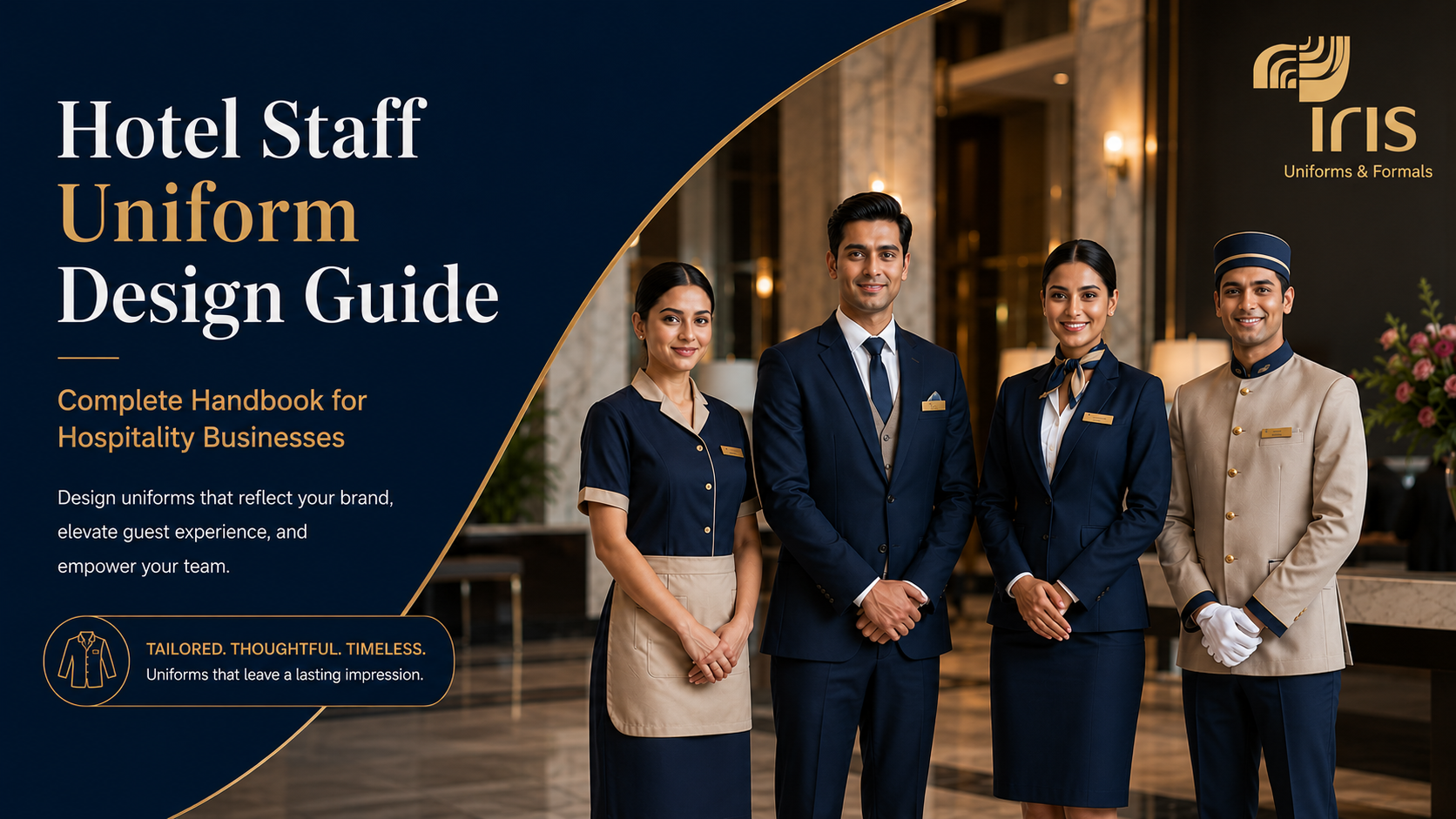
Hotel Staff Uniform Design Guide: Complete Handbook for Hospitality Businesses
Walk into any hotel and within seconds, you’ve already formed an opinion, before a word is spoken, before anyone introduces themselves. A large part of that impression comes from what the staff are wearing.
A well-designed hotel uniform does several things at once. It tells guests what standard of property they’re in. It makes staff easily identifiable across a busy lobby or restaurant floor. It gives employees something to feel proud wearing. And it keeps the visual identity of the brand consistent from the front door to the back corridor.
Still, it should never be appearance that is more important than function. A uniform which looks great in the shoot but leads to discomfort after just four hours of continuous wearing is definitely a trouble, firstly to the employee satisfaction, secondly to the service quality, lastly and ultimately to the guest experience as well.
This guide is all you need to make the proper decisions: styles of uniforms for each department, choosing the material, the psychology of colour branding 2026 trends, and also the usual mistakes hospitality businesses make when they design a uniform with little consideration.
Benefits of Professional Hotel Staff Uniforms
Before getting into the design specifics, it’s worth being clear on what a uniform programme actually delivers when it’s done properly.
- Instant brand recognition – guests spot staff across a crowded space without needing to search for a badge
- Consistent brand impression – every guest interaction starts from the same visual baseline, regardless of shift or location
- Staff confidence and professionalism – employees who feel well-dressed tend to present themselves better; it’s a psychological reality that uniform quality affects behaviour
- Clear departmental differentiation – guests know instinctively who handles check-in versus housekeeping versus restaurant service
- Reduced decision fatigue – a uniform removes the daily “what do I wear” question from every team member’s morning
- Employee equity – uniform dress codes remove visible income disparity between staff members
Those hospitality companies that consider uniforms as part of the overall strategy instead of just a buying activity through the procurement department get better results for both staff and customer satisfaction, lower turnover, and higher guest satisfaction scores.
Types of Hotel Staff Uniforms
Different divisions have profoundly different functional needs. A front desk uniform design must look elegant and commanding even from a distance, while a hotel housekeeping uniform must be able to withstand physical activity, laundry sessions, and wearing all day without losing comfort or good looks.
- Front Desk and Reception: Guests have their first interaction with the host at the reception desk. The wardrobe here could include a well-cut blazer, a neatly tailored shirt or blouse, slim-fit pants, or skirts. Fabrics should be chosen not only for their good looks but also for their ability to keep a professional appearance after a long day of work. Blends of wool, polyester-viscose are typical. Usually, the colors are those of the hotel’s main brand palette.
- Housekeeping: The uniforms that meet such requirements are usually purchased from specialist suppliers. Housekeeping staff perform some of the most physically demanding tasks, so their uniforms must provide flexibility, breathability, durability through frequent industrial washing, and easy maintenance. Stretch fabrics, reinforced seams, and moisture-wicking properties are standard. Darker colors in the lower part of the body conceal dirt better during shifts.
- Food and Beverage (Restaurants Bars Room Service): Divided between front-of-house staff and back-of-house kitchen teams. Work clothes for F&B service workers have to look good while also allowing easy movement for carrying, serving, and clearing. As for kitchen staff uniforms, their main focus will be on heat resistance, simple cleaning together with safety such as chef whites, breathable mesh-back jackets, footwear with non-slip soles.
- Concierge and Bell Staff: These uniforms are usually more formal and have a lot more colour, tailoring, and detail. This is enough that they can actually be the brand color, so to speak. Guests are used to interacting with concierge staff as they are the ones who not only provide them with premium service but also design the uniforms to match these expectations.
- Management and Supervisory: They are differentiated just enough from the rest of the staff at work so that people can recognize them, but not so much that there is a completely different uniform. Instead it is generally through better quality fabric, better cut, or little design features in which they differ from the regular staff. management uniforms with some very subtle branding convey their authority while not being too promotional.
- Spa and Wellness: Continue the theme in the spa cabin with the same soft lines, airy natural fabrics, and subdued colours. The look of the uniform has to support the calm and wellness-oriented atmosphere of the space.
Hotel Uniform Design – Key Elements & Effect
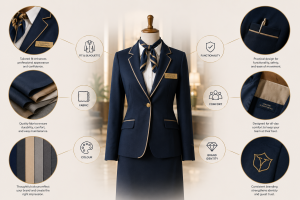
A uniform programme that works has five things in common, regardless of hotel category or brand positioning.
- Function first – the uniform must allow the wearer to do their job properly. If a housekeeper can’t reach high shelves comfortably or a waiter can’t move quickly between tables, the design has failed regardless of how good it looks.
- Durability for the laundry reality – hotel uniforms go through industrial washing cycles hundreds of times over their lifespan. Fabrics and construction need to survive that without fading, shrinking, or distorting. Testing wash performance before full procurement is not optional.
- Comfort across a full shift – a hotel shift runs 8–12 hours. Ergonomic cuts, breathable fabrics, and thoughtful seam placement matter over that duration in ways they don’t for a two-hour wearing.
- Consistent brand alignment – the uniform should be an extension of the hotel’s visual identity, not a separate aesthetic decision. Colour, formality level, and design details should align with everything else the brand communicates.
- Inclusive sizing and fit – a uniform programme that doesn’t fit the actual range of body types on the team is a real operational and morale problem. Extended sizing and gender-inclusive options are now a baseline expectation in 2026, not a premium add-on.
Hotel Uniform Design Trends for 2026
Sustainable Uniforms
Sustainability is no longer just a nice addition to a brand’s lifestyle positioning; it is now a visible part of how hospitality brands demonstrate their environmental commitments. More hotels are adopting sustainable uniforms made from organic cotton, recycled polyester, bamboo blends, and low-impact dye processes as part of their uniform briefs.
Environmentally friendly uniform suppliers are introducing recycled polyester-spandex blends that are tested for up to 100 industrial wash cycles while maintaining colour and fabric performance. One resort chain experienced a 30% reduction in replacement costs along with improved staff satisfaction after switching to sustainable fabrics. The future of hospitality workwear lies in this shift toward responsible materials, durability, and smarter uniform design.
Modern Minimalist Designs
Quiet luxury is the dominant aesthetic in 2026. High-end properties are replacing bold logos and heavy branding with clean tailoring, tonal embroidery, and subtle role identifiers. The message is that quality speaks for itself, and guests associate a refined, understated uniform with a premium experience. This trend is reshaping front desk and management uniform design particularly, with a move away from obvious branded blazers toward considered, minimal pieces that communicate the same authority more subtly.
Gender-Inclusive Uniforms
Gender-neutral sizing and inclusive design options are no longer niche. Hospitality businesses with diverse teams are specifying stretch-based fits, extended size ranges, and adjustable elements (waistbands, hem lengths) that accommodate different body types without requiring completely separate male and female uniform lines. Beyond the equity argument, unisex uniform programmes simplify inventory management and reduce procurement costs, a practical benefit alongside the obvious cultural one.
Department-Specific Needs
The 2026 approach rejects the idea of one uniform system that applies across every department with minor variations. Modular systems, where core brand elements are maintained across a mix-and-match range of role-specific pieces, are gaining ground. Front desk staff get tailored blazers. Housekeeping gets practical stretch pieces. F&B gets layering options suited to both service and kitchen adjacency. The brand remains visually unified; the functional differences between roles are properly addressed.
Budget Considerations
Custom uniforms for a full hotel team represent a real capital expenditure. The most cost-effective approach is a three-to-five year view: higher quality at procurement means lower replacement frequency and lower lifetime cost. Cheaper upfront often means annual replacement rather than multi-year use, plus the staff dissatisfaction that comes with uniforms that don’t perform. The smarter procurement question isn’t “what’s the unit cost?” but “what’s the cost per wear over the service life?”
Hotel Uniform Colour Psychology
Colour does more work in a hotel uniform than most hospitality businesses realise.
- Navy and deep blue – authority, reliability, trust. Consistently chosen for front desk and management roles across luxury and business hotel categories.
- Black – sophistication, formality, premium positioning. Common in luxury F&B and fine dining uniform programmes.
- White and cream – cleanliness, precision, clinical standards. Used in spa, wellness, and kitchen contexts where hygiene messaging matters.
- Earth tones (terracotta, sage, slate) – warmth, approachability, contemporary lifestyle positioning. Growing strongly in boutique and lifestyle hotel brands in 2026.
- Burgundy and forest green – heritage, richness, depth. Frequently used in heritage properties and classic luxury hotels seeking to communicate tradition.
Matching Uniform Colours with Brand Identity
The uniform palette should be pulled directly from the hotel’s brand guidelines, primary, secondary, and accent colours, and then tested in the fabric and lighting conditions of the actual property. Colours read differently in warm lobby lighting versus outdoor natural light. Procurement decisions made from swatches in an office often don’t survive contact with the real environment.
Choosing the Right Fabric for Hotel Uniforms
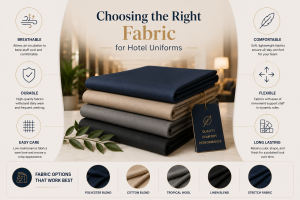
Cotton
Breathable, comfortable, widely accepted for housekeeping and F&B applications. The limitation is performance over industrial wash cycles, pure cotton can shrink and lose shape. Most modern hotel applications use cotton blends rather than 100% cotton.
Polyester Blends
The dominant fabric category for hotel uniforms globally, for good reason. Durable, dimensionally stable through washing, colour-fast, and available in a range of weights and textures. Polyester-viscose blends are the front desk standard; polyester-cotton blends are common in housekeeping. The demand for climate-friendly uniform fabrics has significantly expanded recycled polyester options in 2026.
Linen
Excellent breathability and a refined aesthetic, well-suited to resort, spa, and boutique properties in warm climates. Wrinkles easily and requires careful laundering, which limits its use to contexts where the aesthetics justify the care requirements.
Stretch Fabrics
Essential for housekeeping and any physically active role. Elastane or spandex content allows full range of motion without restriction. In 2026, stretch properties are increasingly specified in F&B uniforms too, the movement demands of service work benefit from the same flexibility.
Moisture-Wicking Materials
Standard in housekeeping and kitchen uniforms. Technical fabrics that draw moisture away from the skin and allow faster evaporation make a meaningful difference to comfort and hygiene in high-activity roles.
Sustainable Fabric Options
Organic cotton, recycled polyester (rPET from plastic bottles), bamboo blends, and Tencel (lyocell) are all in active use in hospitality uniform programmes. Bamboo is notably antimicrobial, an advantage in spa and wellness contexts. GOTS-certified organic cotton provides a traceable sustainability credential for brands that need to communicate supply chain standards.
Branding Your Hotel Through Staff Uniforms
Logo Placement Best Practices
Standard placement is left chest for most hospitality roles, visible and readable from a natural social interaction distance. Senior management and front-facing concierge staff sometimes use embroidered chest or sleeve placement to add formality. Avoid oversized logos, the 2026 trend is toward restraint, and a logo that dominates the garment signals insecurity about the brand rather than confidence. Effective uniform logo branding for business helps maintain a professional identity without overpowering the overall uniform design.
Embroidery vs Printing
Embroidery is the quality standard for hotel uniforms. It’s durable across industrial washing, tactile, and communicates permanence and investment. Printing is less expensive but fades over time and rarely survives the same wash volume as embroidery. For most hotel uniform budgets, embroidery on key placements with a solid base fabric is the correct combination.
Custom Name Tags
Personalisation at the individual level, name tags, name embroidery, contributes to guest perception of warmth and service quality. It also signals to staff that they’re being treated as individuals within a team, which has a measurable morale effect.
Consistent Brand Messaging
The uniform is one touchpoint in the overall brand experience. It should align with the hotel’s broader visual standards, website, printed collateral, signage, not exist as a separate aesthetic decision. Brief your uniform supplier with brand guidelines, not just colour preferences.
Common Hotel Uniform Design Mistakes to Avoid
Ignoring employee comfort
Uniforms designed by management for appearance rarely survive the reality of what staff actually do in them. Involve team members from different departments in the brief, their feedback on movement, temperature, and practical features is more valuable than most design agencies’ initial concepts.
Overcomplicated designs
More design elements rarely mean a better uniform. A clear silhouette in quality fabric with considered branding outperforms a complicated uniform with multiple colours, patterns, and decorative details in almost every hospitality context.
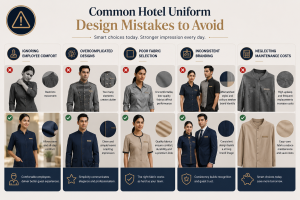
Poor fabric selection
Choosing fabric based on initial appearance without testing wash performance is the most expensive mistake in hotel uniform procurement. Always test samples through the same industrial wash process the laundered uniforms will experience. Experienced hotel uniform suppliers should be able to guide businesses on fabric performance, durability, and maintenance requirements before final production.
Inconsistent branding
When different departments or properties have drifted from the same brand standard, the visual incoherence reads as Disorder to guests. A uniform audit that brings all departments back to a consistent baseline is often overdue by the time it’s commissioned.
Neglecting maintenance costs
The total cost of a uniform programme includes replacement frequency, laundering costs, and repair. Programmes built on cheap fabrics that require frequent replacement consistently cost more over a three-to-five year period than programmes built on quality materials with longer service lives.
Hotel Uniform Design Checklist
Before committing to a uniform programme, work through this checklist:
- Departmental requirements documented, what does each role actually do in this uniform?
- Brand guidelines shared with the supplier, colour palette, logo files, tone and positioning
- Fabric samples tested through industrial wash cycles before final selection
- Sizing range confirmed, does it cover the actual range of your team?
- Gender-inclusive options specified or ruled out with intention
- Maintenance and care requirements confirmed with housekeeping or laundry team
- Embroidery placements signed off on a physical sample, not a digital mockup
- Replacement timeline and budget agreed before first procurement
- Staff feedback gathered during the brief stage, not after delivery
Conclusion
Hotel uniforms are not a procurement afterthought. They’re a daily brand communication, a staff wellbeing decision, and a guest experience component, all at once. Getting them right requires understanding what each department actually needs, choosing fabrics that survive the operational reality, and designing with brand consistency as a genuine priority.
In 2026, the best hotel uniform programmes are built on comfort, sustainability, inclusive design, and minimalist brand expression. The gap between properties that treat this seriously and those that don’t is visible from the moment a guest walks through the door.
Frequently Asked Questions
What is the best fabric for hotel staff uniforms?
Polyester-viscose blends for front desk and management; stretch polyester-cotton or moisture-wicking blends for housekeeping and F&B. For sustainable programmes, recycled polyester (rPET) and organic cotton blends are now viable across most hotel uniform applications.
What colours work best for luxury hotel uniforms?
Deep navy, black, and rich earth tones are the dominant luxury palette in 2026. The trend is toward muted, sophisticated colour rather than bold primary branding. Palette should always be derived from the hotel’s existing brand guidelines.
How much do custom hotel uniforms cost?
Costs vary significantly by fabric quality, volume, and design complexity. Budget-tier programmes for basic hospitality roles typically start at ₹800–₹2,000 per garment. Premium custom programmes for luxury properties can reach ₹5,000–₹15,000 per garment for fully tailored pieces with quality fabrics and detailing.
Are sustainable hotel uniforms worth the investment?
In most cases, yes. Sustainable fabrics typically carry a 15–30% cost premium at procurement but perform better through industrial wash cycles, require less frequent replacement, and are increasingly a stated requirement for hotels with public sustainability commitments. One resort chain that switched to sustainable fabrics reported a 30% reduction in replacement costs.
How can hotel uniforms improve guest experience?
Primarily through instant staff recognition (guests can find who they need quickly), visual reinforcement of brand standards, and the confidence a well-dressed team communicates, which translates directly to the tone of the service interaction.
What are the latest trends in hotel staff uniform design?
In 2026: sustainable and recycled fabrics as standard, minimalist “quiet luxury” aesthetics replacing heavy branding, gender-inclusive sizing and fit options, modular department-specific systems, and RFID integration for inventory management.