

Why Sustainable Uniforms Are Becoming the Future of Workwear?
The corporate attitude towards workwear is evolving. Enterprises in hotel, office, and industrial domains are not only revisiting what their employees wear every day, but also who produces the expression and what is done with it when it becomes worn out. In fact, sustainable uniforms are supporting this shift by focusing on responsible materials, ethical manufacturing, longer garment life, and reduced waste. Besides, in 2026, opting for green uniforms for employees may not only be related to ethical issues but also be a commercial imperative.
What Are Sustainable Uniforms?
Workwear pieces that are considered as sustainable uniforms are those that have been planned and constructed to minimize harm to the environment, starting from the raw materials to the methods of making, usage, and disposal.
The difference shows up at every stage:
- Materials – organic cotton, recycled polyester (rPET), bamboo, or TENCEL Lyocell are among materials replacing conventional synthetics
- Manufacturing – less water use, less chemicals, sourcing in a responsible manner
- Durability – made to last longer so that we don’t get new ones so frequently
- End of life – recyclable, biodegradable, or designed for take-back and repurposing
What Makes Sustainable Uniforms Different from Conventional Workwear?
The core difference is lifecycle thinking. Conventional workwear is designed around short-term cost. Sustainable uniforms are designed around total impact.
| Base | Conventional | Sustainable |
| Materials | Virgin polyester, standard cotton | Organic cotton, rPET, TENCEL, hemp |
| Durability | Standard | Up to 29% longer lifespan |
| End of life | Landfill | Recyclable or biodegradable |
| Long-term cost | Higher replacement frequency | Lower total cost over time |
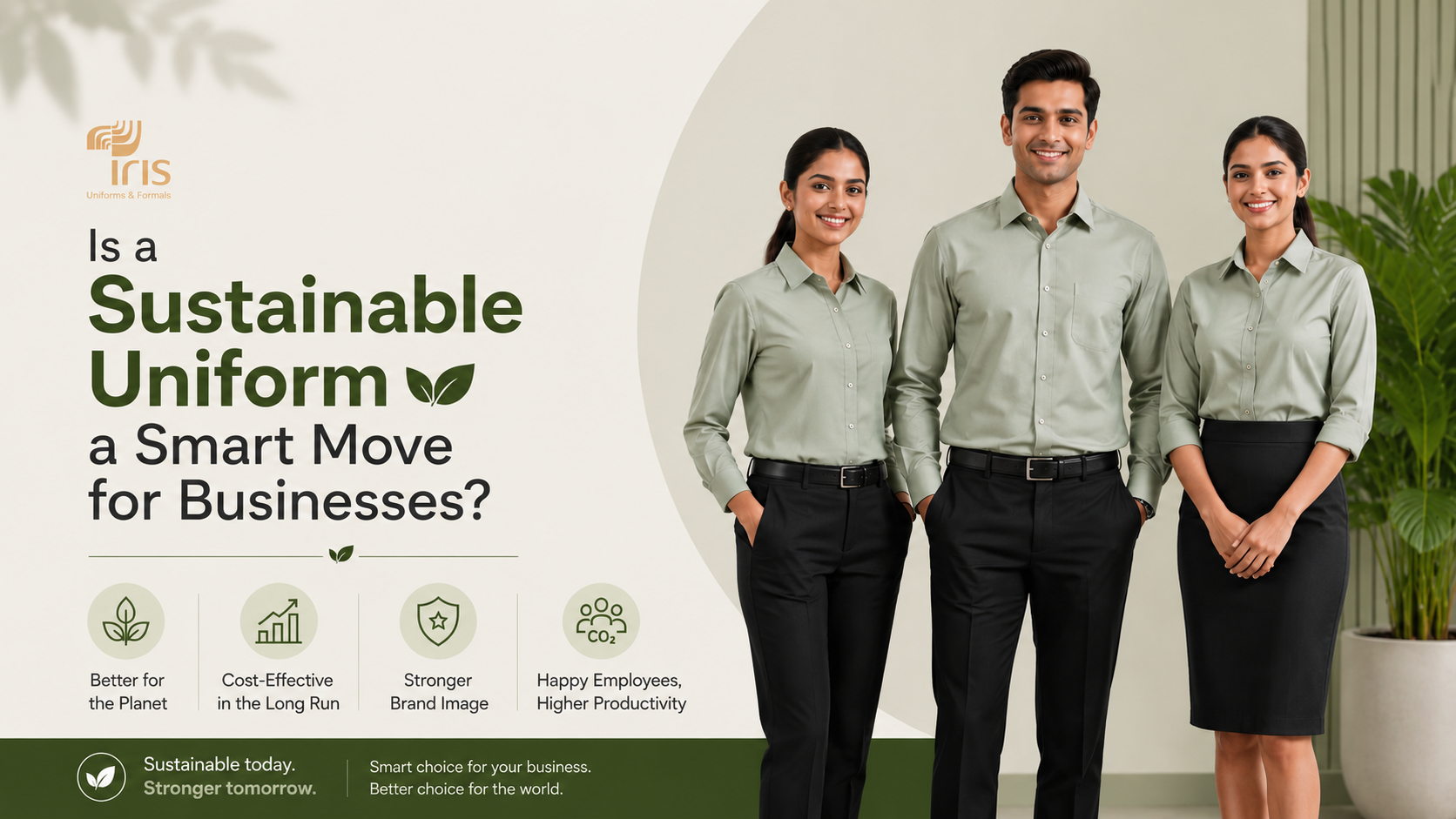
Is a Sustainable Uniform a Smart Move for Businesses?
Yes, and such a case is most convincing when uniforms are worn every day.
Corporate Wear: Office uniforms made of organic cotton or TENCEL blends are able to maintain their shapes and colours for longer even after many washes, which not only helps in reducing the cost of replacing the clothes but also meets the environmental, social and governance (ESG) objectives. For businesses ordering made-to-measure corporate uniforms, the change does not mean a trade-off of the design or the brand consistency.
Hotel and Hospitality Wear: Bamboo and TENCEL-based hospitality uniforms have the natural antibacterial and moisture-absorbing features that make them very suitable for front-of-house staff. Besides tolerating repeated washing, they also give the signal of the hotel’s sustainability efforts to the guests who are becoming more and more aware of such things. Customized uniforms in eco-friendly materials constitute one of the most prominent ways a hotel can prove its green commitments.

Why Are Businesses Switching to Sustainable Uniforms?
By 2025, global workwear market is predicted to be worth USD 110. 34 billion. Sustainable development is one of the major pillars causing the transformation of the sector as 49% of the manufacturers have already switched to sustainable fabrics, and an additional 52% of organizations have made their decisions to devote more to durable materials. The fashion industry produces 92 million tonnes of textile waste every year. Uniforms, which are worn every day and are being replaced frequently, make a significant portion of that figure.
- ESG commitments – sustainable uniforms are a visible, measurable part of environmental reporting
- Regulation – green procurement mandates are becoming standard across energy, infrastructure, and public sectors
- Lower long-term cost – it is because eco-friendly workwear can last upto 29% longer that it lead to lesser workwear being replaced over a period of time
- Brand perception – 66% of global consumers say they prefer brands that demonstrate sustainability commitments
Sustainable Uniform Maintenance for the Long Run
Getting sustainable uniforms is just a start. It is the way they are maintained that ultimately decides their life cycle.
- Lower temperatures like 30°C are best for washing – not only do they prolong the fabric’s life but also help reduce energy consumption
- Detergents with an eco-certification are recommended – they are milder on fibers and at the same time, they Much reduce chemical waste
- Air dry where possible – tumble drying is one of the most damaging processes for garment longevity
- Repair before replacing – a small fix extends a garment’s life by months
- Rotate stock evenly – distributes wear across the full inventory
How to Select the Best Sustainable Uniform Supplier
Look for these before committing:
- Certifications -Getting certification from reliable sources like GOTS (Global Organic Textile Standard) for organic cotton, OEKO-TEX Standard 100 for chemical safety, GRS for recycled content
- Manufacturing transparency – a genuine sustainable corporate uniform supplier should be able to tell you exactly where and how garments are made.
- Durability data – ask about wash cycle performance and typical replacement frequency
- Lifecycle assessment – understand how the supplier evaluates environmental impact from fabric selection to disposal.
- Customisation capability – logos, colours, and cuts in sustainable materials without compromising on finish
- End-of-life programmes – take-back or recycling schemes that close the loop
A note on manufacturers: Working directly with uniform manufacturers in India gives businesses more control over sourcing, production, and pricing than buying through intermediaries. India is one of the world’s leading producers of organic cotton, and direct manufacturer relationships deliver quality and cost advantages that aren’t available further down the supply chain. To understand what’s involved in larger orders, explore bulk uniform manufacturing at Iriswear.
Common Questions We Hear
How Do Sustainable Uniforms Help Reduce Textile Waste?
Eco-friendly uniforms are more durable which means garments don’t have to be replaced as often. Besides, when organic clothes grow old and their time is up, they are biodegradable and recycle material programmes help turning old clothes into raw materials rather than the landfill. Using rPET only, can bring a reduction in energy consumption by up to 59% and carbon emissions by up to 32% compared to virgin polyester.
Are Sustainable Uniforms the Future of Corporate Workwear?
Everything points towards the affirmative. Workwear is 49% sustainable material adoption, the number of green procurement mandates are going up, and ESG reporting includes supply chain sustainability as a measurable metric. Corporate uniform trends will be continuously updated, sustainability will come to be considered not a distinguishing feature but a baseline expectation.
Which Fabrics Are Best for Sustainable Uniforms?
- TENCEL Lyocell – closed-loop production biodegradable antimicrobial, outstanding colour retention. Ideal for corporate and hospitality uniforms
- Organic cotton – can be certified by GOTS biodegradable widely known and comfortable for most workwear
- Recycled polyester (rPET) – supports circularity by converting recycled materials into durable workwear fabrics.
- Bamboo – antibacterial properties biodegradable suitable for restaurants and healthcare situations
For most businesses, the right answer is a blend, base fabric in TENCEL or organic cotton, with rPET reinforcement where durability is needed.
Conclusion
Sustainable uniforms are where the workwear industry is heading. The businesses establishing eco-friendly programmes now are building something that serves them better over the long term, in cost, in compliance, and in how they’re seen.
Ready to explore what this looks like for your team? Get in touch with Iriswear, we’ll help you find the right materials, design, and manufacturing approach for your needs.





Pingback: Custom Aprons for Small Business | Build Your Brand