
How Custom Airline Uniform Design Strengthens Airline Brand Identity
A passenger stepping onto a flight forms an impression within the first thirty seconds. Most of that impression is not built by the seat or the cabin; it is built by the person standing at the door to welcome them. That person is wearing your brand.
When it comes to aviation, brand identity is undoubtedly a crucial factor that could make or break a company. This means that two airlines can fly the same route with the same aircrafts and be charging the same ticket prices, and yet one airline can have much stronger brand loyalty than the other. The difference can usually be attributed to a combination of different sensory factors and emotional signals that create a lasting image of an airline. Among these signals, uniforms possess remarkable power. This is so because a uniform is a human element that moves and can be seen from the moment a passenger enters the airport and until they board an airplane.
A 2025 academic study published in Cogent Business and Management found that cabin crew appearance significantly affects passenger brand imagery and repurchase intention, meaning a passenger’s decision to fly with the same airline again is measurably influenced by how the crew looked and carried themselves. Custom airline uniforms are not a design indulgence. They are a commercial decision with trackable impact on loyalty.
The Uniform as a Brand Medium, Not Just Workwear
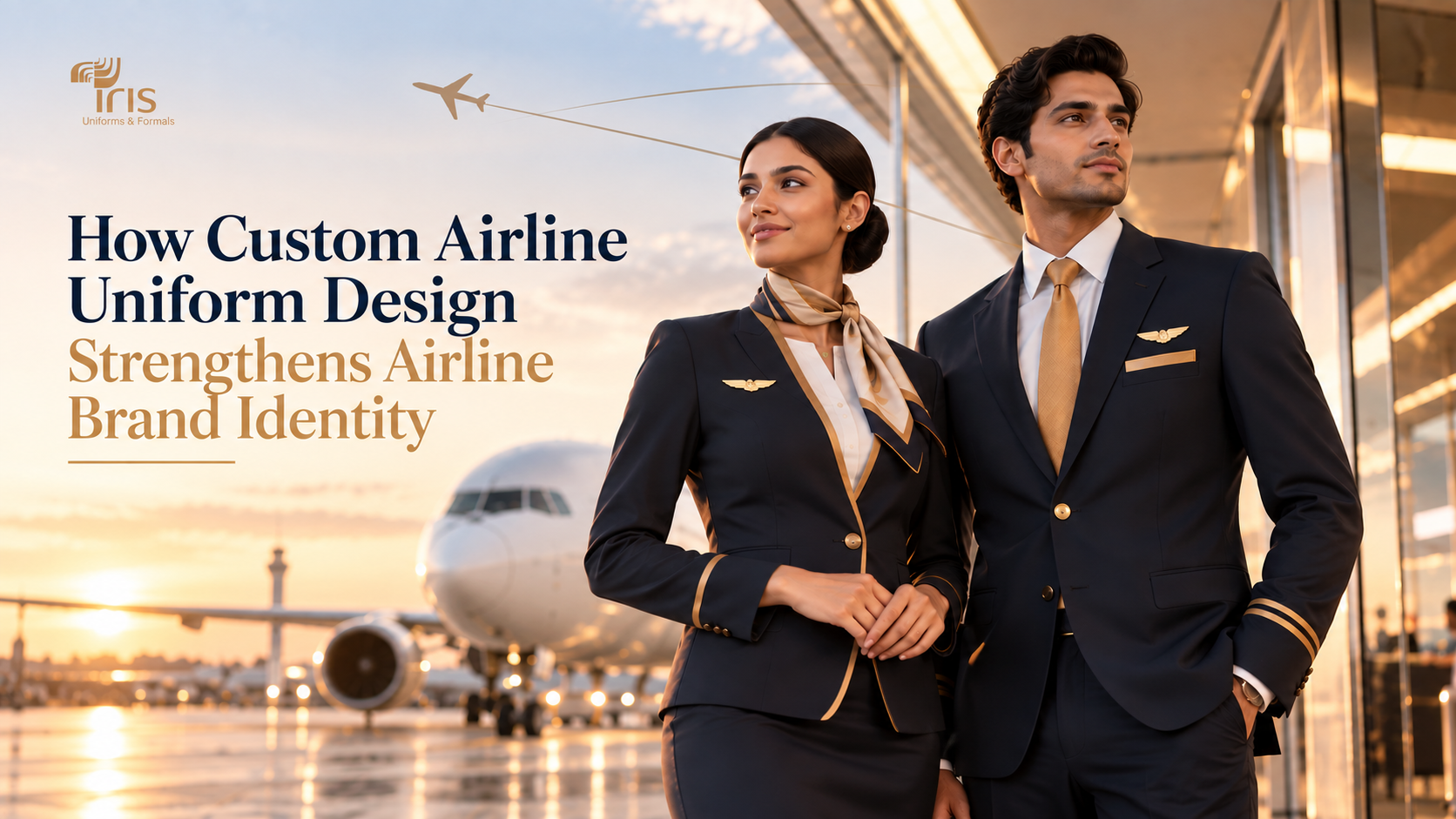
Most industries think about uniforms as functional workwear with branding added, a logo on a shirt, a colour scheme that matches the website. Aviation works differently. The uniform is the brand in motion. It travels through airports across multiple countries, appears in every passenger photograph taken on the aircraft, and stands in the background of every cabin safety demonstration. It has more cumulative visual impressions than most billboard campaigns.
Lufthansa understood this when they commissioned Hugo Boss to redesign their crew uniforms ahead of the airline’s 100th anniversary, a rollout beginning in Q4 2026. While the characteristic colors of dark blue and yellow have remained the same, contemporary tailoring was added, and a unique cape was introduced to give a connection of the airline’s traditions with the modern design. The choice to cooperate with a fashion house on what is primarily workwear indicates the seriousness with which major airlines view the use of uniforms as a brand element.
Earlier in 2026, flyadeal presented new uniforms for its cabin crew, referring to them as the “natural evolution of the brand identity of flyadeal.” Multiple rounds of pre-production tests conducted by the airline among crews were necessary to ensure that among those who wear the uniform daily are the most sincere representatives of the brand, who can also act as harshest critics of the design.
These are not isolated examples. They reflect a broader pattern in 2026 aviation: carriers increasingly treating uniform redesign as a strategic brand investment rather than a periodic replacement exercise.
What Custom Design Actually Delivers, Beyond Aesthetics

When airlines commission custom airline uniforms rather than adapting off-the-shelf workwear, the difference shows up in several specific ways.
Colour as Brand Language
- The colours in an airline’s livery, cabin interiors, and website all carry associations; the uniform should speak the same colour language, not a generic corporate approximation of it
- When uniforms are custom made, it is possible to control colours closely. For example, it is not possible to get the exact shade of Air India’s deep red or IndiGo’s blue with a catalogue order
- Accents like piping, linings, embroidery, and buttons are where designers can use secondary brand colours to enhance the overall colour scheme
Cultural Identity Through Design
- In the case of Indian airlines, the uniform designs are a platform to showcase heritage in terms of fabric, cut and details that highlight a unique identity in the global marketplace
- A saree drape imitating the look of a sari worn by women cabin crew of Air India is one of the most memorable uniform design choices in aviation that highlights Indian cultural identity
- Motifs, weave references, and regional craft elements woven into the design create cultural storytelling that generic workwear cannot replicate
Consistency Across Every Role
- On different segments of the same flight passengers encounter the cabin crew, ground services staff, check-in clerks and baggage handlers, if all of them wear different uniforms, the contact with the company won’t convince the customer of the company’s identity.
- Custom design allows differentiating between the types of jobs, while all uniforms belong to the same family, i.e. different shapes and levels of formalwear but using same colours and general appearance.
Comfort and Function Cannot Be Separated from Brand
A uniform that curtails freedom of movement, holds in heat, or needs continuous adjustment gives customers a clear signal that the airline didn’t consider how its customers would feel. As of 2026, the airline industry has been caught up with making comfort and gender tolerance part of the crew design partly as a result of negotiations with trade unions, partly due to a cultural impulse towards the creation of crew uniforms oriented towards the needs of the wearers.
The practical case for comfort-focused design is also a brand case. When crew members move freely and comfortably, cabin service is faster and more confident. When uniforms are not a distraction, crew attention stays on passengers. The design principles behind cabin crew uniforms for comfort and movement directly affect how the brand is perceived in every passenger interaction.
Fabric choice is where this balance is made or lost. Aviation environments are demanding: temperature swings between tarmac and cabin, twelve-hour shifts, high physical activity during boarding and service. A fabric that photographs well but fails at hour nine of a flight has failed the brand, not just the crew member wearing it. The fabric considerations for airport ground staff reflect a different set of demands from cabin crew: outdoor exposure, physical handling, and varying weather, but the principle is the same: the material has to perform before it can represent.
What a Custom Design Process Looks Like
Airlines that approach uniform design properly, whether through an in-house team or through a specialist airline uniforms manufacturer, tend to follow a structured process that involves far more than choosing colours from a swatch.
Brand and Passenger Research
- Understanding the airline’s brand guidelines, passenger demographics, and the emotional experience the airline wants to deliver informs every design decision, from silhouette to fabric weight to accessories
- What a budget carrier wants its uniform to communicate is very different from what a full-service carrier or a regional heritage airline wants
Crew Input Before Production
- Crew members who wear the uniform for twelve hours know things about fit, movement, and comfort that no designer working from a pattern table will discover independently
- Incorporating structured crew feedback, as flyadeal did in 2026, before final production reduces costly revisions and produces a uniform that crew members wear with confidence rather than reluctance
Multi-Role Consistency
- A comprehensive uniform program consists of every member of the airline industry’s workforce, such as cabin crew, cockpit crew and ground staff, among others, to ensure that all of them have meet their distinct functional requirements while maintaining the same visual identity.
- Accessories, headwear, footwear guidelines, and grooming standards are part of the full brand picture, not afterthoughts
Production Quality and Durability
- Aviation uniforms are industrial-use garments that need to maintain their appearance through hundreds of washes and twelve-hour wear cycles
- Colour fastness, fabric durability, and stitching quality at the commercial scale that airlines require are specialist capabilities; not all manufacturers can reliably deliver them
Why Indian Airlines Should Think Differently About Uniform Design
The aviation industry in India is currently experiencing substantial growth. Recent reports by DGCA indicated that domestic traffic in India has reached 152 million passengers in FY 2024-25; and international travel also continues to grow. The presence of newer airlines and newer routes brings in more competition, making the need for brand differentiation all the more critical.
For Indian carriers specifically, a custom-designed uniform is one of the clearest ways to communicate identity in a market where the product itself, the aircraft, the route, the fare class, is increasingly similar across carriers. The uniform travels internationally, represents the airline to passengers from dozens of countries, and appears in media coverage every time the airline makes news. That visibility has value beyond the flight itself.
Working with a custom airline uniforms manufacturer in India like Iriswear gives domestic carriers the advantage of a manufacturing partner who understands Indian fabric traditions, Indian body sizing ranges, and the specific performance requirements of Indian aviation environments, alongside the design capability to translate a brand brief into a uniform programme that actually delivers at every touchpoint.
Iriswear’s airline uniform programme covers cabin crew, ground staff, and cockpit crew, designed from the brief stage and manufactured to the durability and consistency standards that aviation demands. As a uniform manufacturer with deep experience across hospitality and aviation, we understand that the brief is not “make something that looks good.” It is “make something that represents this airline accurately, in every airport, every day, at scale.”
Conclusion
A uniform that accurately represents a brand cannot be achieved simply by attaching a logo to a generic uniform design. It must begin with the brand, consider operational needs, engage with wearers, and select materials that perform well. This process may take longer and be more expensive than purchasing a uniform out of a catalogue, but the effect is apparent each time a passenger boards a plane and is multiplied by millions of flights.